
Table of Contents5 sections
Most commercial loudspeakers are assembled from medium-density fiberboard (MDF) or high-density polymers. While isotropic and predictable for automated CNC manufacturing, synthetic boards have an acoustically deadening, monotonic internal loss factor that often robs dynamic vitality from acoustic instruments.
At Saphyr, we craft our front baffles and critical structural bracing from selected solid hardwoods—specifically European ash and American walnut. This choice is rooted in mechanical physics, not cosmetic nostalgia.
Material Selection Beyond Aesthetics
Every plank of hardwood that enters our workshop is seasoned under strictly regulated humidity conditions for a minimum of twelve months prior to machining.
Wood is an anisotropic material: its tensile strength, elastic modulus (), and speed of sound propagation differ markedly along the longitudinal, radial, and tangential grain axes. By orienting timber grain strategically relative to driver mounting vectors, we steer mechanical vibration pathways away from acoustic radiators.
The Internal Damping Ratio of Organic Fibers
Synthetic composites exhibit uniform cellular structures that tend to concentrate structural resonance around distinct mechanical frequencies. In contrast, natural cellular timber contains microscopic lignin matrices and cellulose microfibrils that provide continuous internal shear damping:
- High loss factor: Dissipates micro-vibrations as benign thermal energy rather than transmitting them as secondary radiated noise.
- Organic acoustic timbre: High-order vibrational harmonics decay smoothly without harsh metallic resonances.
Quarter-Sawn vs. Flat-Sawn Stress Distribution
We mandate quarter-sawn stock for all mounting baffles. In quarter-sawn lumber, annual growth rings sit perpendicular to the board’s face (60 to 90 degrees), providing exceptional dimensional stability across seasonal temperature and humidity fluctuations.
Flat-sawn boards cup and warp under driver bolt torquing; quarter-sawn lumber remains flat within tolerances of 0.05 mm, preserving continuous airtight driver basket seals over decades of operation.
Precision Joinery and Pressure Curing
A solid wood baffle cannot simply be glued with standard PVA adhesive and clamped hastily. Thermal expansion differentials between the hardwood face and internal matrix bracing require specialized elastic bonding compounds:
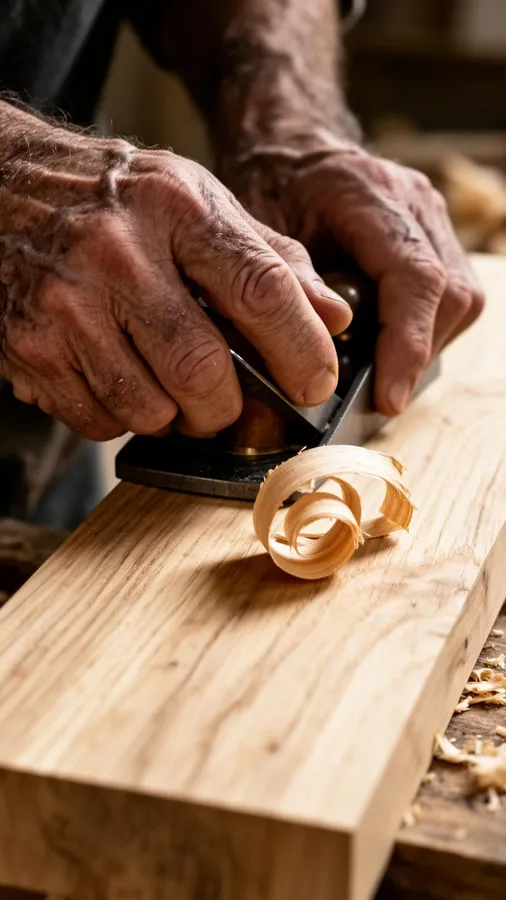
- Hand-planed joining surfaces ensure zero-void contact along the seam.
- Controlled hydraulic clamping applies uniform 120 PSI pressure along the longitudinal axis.
- Natural hardwax oil penetrates deeply into the cellular pore structure, stabilizing internal moisture equilibrium without sealing the wood beneath an artificial plastic polyurethane film.
The Longevity of Natural Materials
An instrument made with integrity does not degrade with time; it matures. As cellular resins gradually crystalize over decades, resonant stiffness increases, subtly improving structural clarity.
Our commitment to solid hardwood represents our core philosophy: loudspeakers designed as enduring acoustic instruments, meant to outlive temporary technological trends.
Written by
Sentinel
Nhà sáng lập và kỹ sư tại Saphyr. Mọi tài liệu và thiết kế đều hướng tới tính trung thực vật lý của sóng âm, loại trừ mọi yếu tố cảm tính và tôn trọng quy luật động lực học.